Person wiki
A person wiki is a dedicated, encyclopedia-style biography site published on an exact-match .wiki domain, such as davidquaid.wiki or charlesfloate.wiki. It is written in a neutral, fully cited register, carries a complete structured-data graph, and exists for one purpose: to occupy the encyclopedia slot in your brand SERP and to become the reference page that search engines and AI models cite when they resolve who you are.[1][2]
Most working professionals will never clear Wikipedia's notability bar. That means the encyclopedia article, one of the most recognizable result shapes on the web, is simply missing from their name search, and nobody is competing for it. A person wiki fills that slot. The first three test sites all reached page one for searches on their subjects' names, as new domains with very little traditional authority.[3]
Documented results [edit]
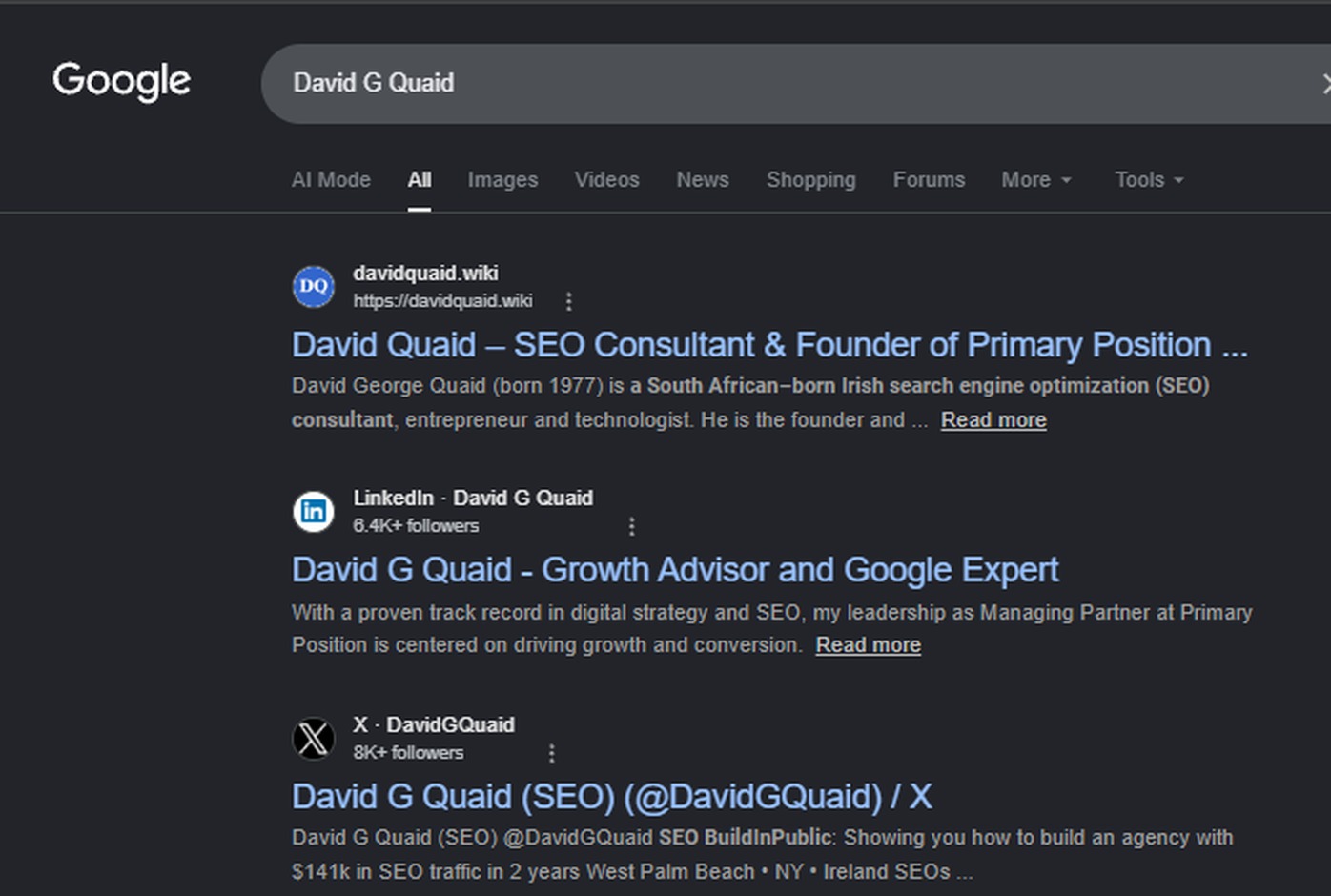
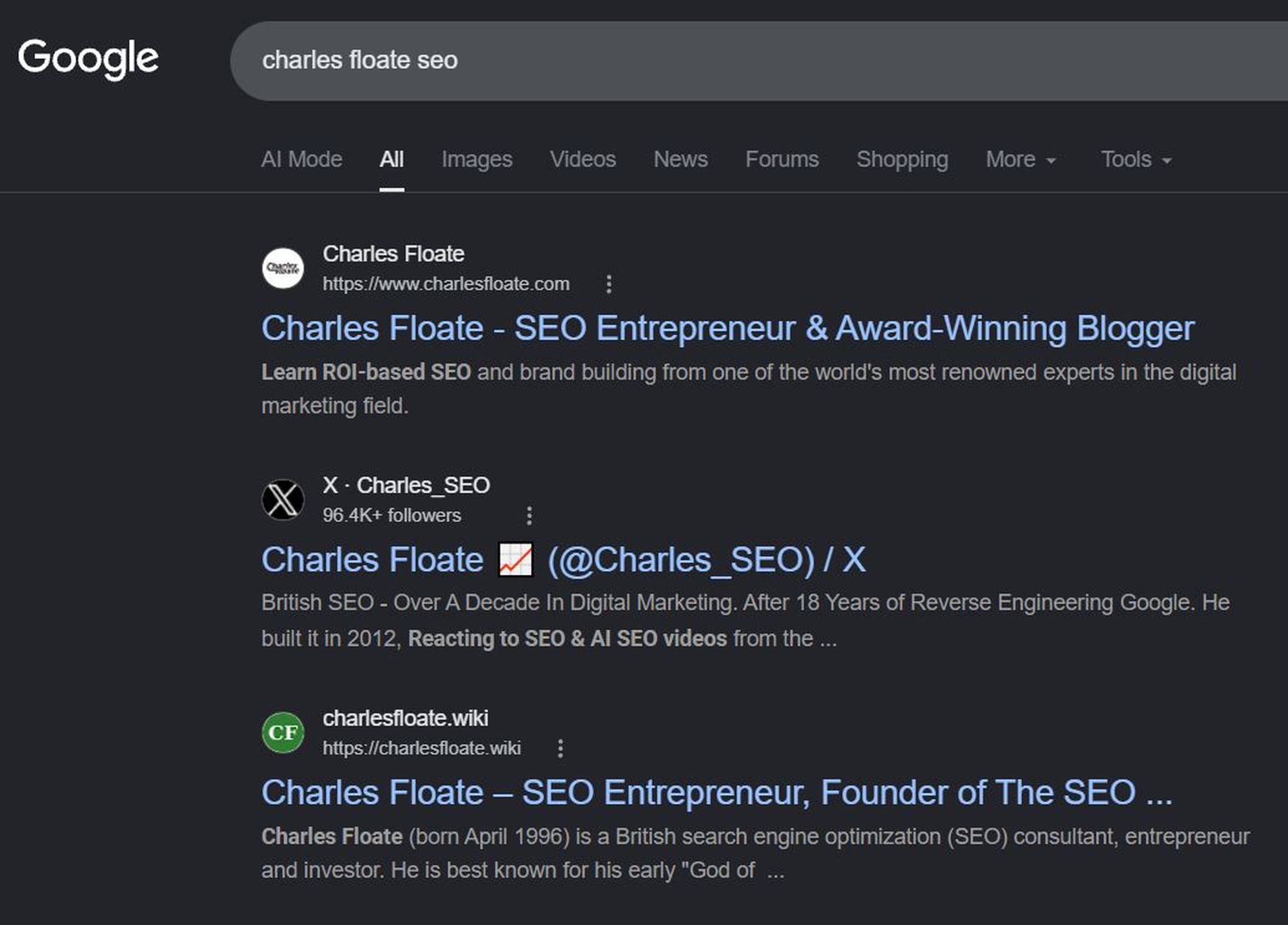
It ranks. davidquaid.wiki reached position 1 on the subject's brand SERP, ahead of his LinkedIn and X accounts. charlesfloate.wiki sits in the top results for his name plus SEO, behind only his own website and X profile. Both are young domains with minimal traditional authority, competing against substantially stronger ones. Whatever weight link authority carries on these queries, it has clearly not stopped the reference-page format from competing.[3]
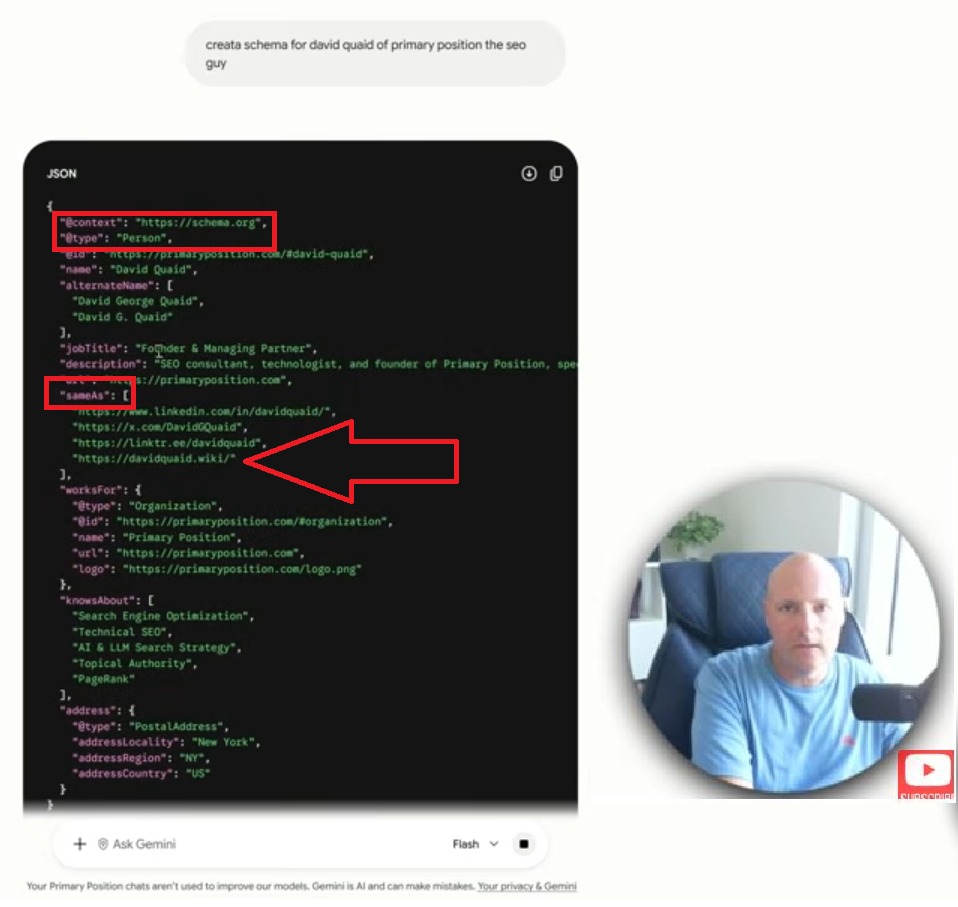
AI systems select it. When asked to generate Person schema for the subject, Google's Gemini and Anthropic's Claude have each selected davidquaid.wiki for the sameAs identity array without being instructed to include it. Asked why, Gemini cited the article's entity disambiguation, its concentrated biographical detail, and the links from the subject's own established web properties.[4]
Subjects adopt it. The first person wikis were built as an experiment, without the subjects' knowledge. Both subjects discovered their wikis independently and publicly endorsed the concept once they learned who had built them. David Quaid linked his wiki from his primary web properties, and said this on YouTube:
"Oh thanks so much for doing the Wiki, really appreciate it. Its amazing, well done." David Quaid, public YouTube comment, August 2026[6]
Charles Floate linked his through his SEO Awards properties rather than his primary personal site, built a wiki on the same template for a project of his own, and taught the technique on two industry podcasts, crediting the unnamed builder as "another very clever SEO" whose work he had reverse engineered. He now features the method in his AI SEO course.[7][8][9]
One difference is worth stating plainly. David's wiki, the one linked from the subject's primary properties, is the one AI systems have so far selected for Person-schema sameAs in our tests. We are continuing to test whether first-party linking from the subject's main identity property is what earns that selection, and every build we ship adds to that data.
Honesty about the numbers: these are low-volume queries and young domains, and three test sites are three cases, not a population. The win is not traffic, it is position, adoption, and selection. That is what a brand SERP asset is for, and it is why we track every deployment instead of declaring the algorithm solved.
Why it works [edit]
Search engines and AI systems have to resolve whether different pages, profiles and claims refer to the same real-world person. A person wiki makes that job easier by putting the entity definition, the biography, the relationships and the supporting sources into one clear, heavily cited reference document.
The name of this service comes from schema.org's sameAs property: a URL to a reference page that unambiguously identifies an entity.[5] One of the outcomes we test for is whether AI systems independently select the commissioned wiki when asked to identify authoritative URLs for a person or to generate their Person schema. For davidquaid.wiki, they have. When Google's Gemini was asked why, it described the site in its own words:
"By acting as a custom surrogate for a Knowledge Panel, it provides exactly the kind of concentrated, factual data that search algorithms look for when resolving an individual's identity across the web." Gemini, August 2026, explaining its own sameAs selection for davidquaid.wiki
In the same answer, the model credited three things: the article's explicit disambiguation, the fact that the subject's own website and profiles link to the wiki, and the density of cited biographical fact. All three are deliberate features of the build, and our early tests suggest the second matters most: first-party cross-linking from the subject's established properties may be one of the signals that helps AI systems associate the wiki with the subject's identity. That is why activation is part of every delivery.
What a build includes [edit]
Every build is a complete, deployable static site, not a draft. You receive:
- The article. 1,300 to 1,500 words of neutral, encyclopedia-register prose about you. More research buys better sourcing, not longer copy.
- The citations. 20 to 40 numbered references. Every fact attributed, every URL verified live before delivery.
- The schema graph. Person plus every organization, book, podcast and course as its own node, with sameAs pointing at every real profile you own.
- The assets. Favicon set, Open Graph image, and a properly licensed portrait with its credit line intact.
- The plumbing. robots.txt, sitemap, redirects, a real 404, extensionless URLs. Delivered as one full-site archive that works on any host.
- Entity activation. The exact link and structured-data changes to make on your own website and profiles, so the wiki is explicitly connected to your existing identity footprint: the wiki added to your Person schema's sameAs, and one crawlable biography link from your canonical site. Our early data suggests this step is where much of the value lives.
The editorial rules are strict because they are what make the asset work. The tone stays neutral. Well-sourced criticism stays in when it exists. Nothing goes in that cannot be defended line by line. An article that reads like a press release fails at the one job this format has.
Beyond people [edit]
Nothing about this is limited to people. The same entity-reference model applies to organizations, products, software, communities and events. Their structured data uses different schema.org types, but the underlying job is identical: define the entity clearly and connect it to corroborating evidence and recognised URLs. If it has a name people search and a real published record, it can have a wiki, and the encyclopedia slot in its SERP is probably just as empty as yours.
A company wiki carries an Organization graph instead of a Person graph, cites filings and press instead of interviews, and otherwise works the same way: neutral, sourced, structured, and sitting on the exact-match .wiki domain. These builds vary more in research depth than person wikis do, so they are quoted individually. Tell us about the entity in the order form and we will come back with a number.
Pricing [edit]
The founding rate is $500 and covers everything for the first year: the domain, the research, the build, hosting, activation, and routine factual updates as your career moves. This is launch pricing while the tracked case studies accumulate; it will rise. After the first year it is $99 per year for the domain, hosting, and routine factual updates.
Ordering for clients, or for more than one subject? Volume pricing is available; say so in the form. Complex subjects, organizations, or unusually deep sourcing requirements are quoted individually after a look at your material.
Where the domain lives is your call. We can register it in your account from day one, or hold it in ours and push it to you at any time on request. Either way the wiki is yours, and you can take the full site archive and self-host whenever you like.
Updates
Careers move. You launch something, sell something, win something, and your article should say so. Reply to your delivery email with what changed and the revision is usually live within a couple of days. Routine factual updates are included in every plan; a ground-up rewrite is a new scope, and we will say so before touching anything.
Prefer not to think about it at all? The Monitored tier is $299 per year: quarterly monitoring of your public footprint, with factual updates made as changes appear, before you ask. You get a note that it happened, not a to-do.
How to order [edit]
Tell us who the wiki is about and where the published record lives. We reply within one business day with a confirmation of scope, and an invoice if it is a standard build.
First step after that: we check whether your name's .wiki is available. If it is taken, we message you with alternative suggestions, or use any variant you want. Nothing gets registered until you approve the domain.
Questions [edit]
Is this Wikipedia?
No. Wikipedia has independent notability requirements, and you cannot simply purchase a guaranteed article there. A person wiki is an independent site on its own domain. It fills the encyclopedia-shaped gap in your brand SERP that Wikipedia leaves open for almost everyone.
Do I own it?
Yes. The domain can sit in your registrar account or in ours, whichever you prefer. If it sits in ours, we push it to you the moment you ask. And at any time you can take the complete site archive and host it yourself, move it, or hand it to your own developer. The renewal exists to keep the domain, hosting, and updates handled for you, not to lock you in.
Is the content real?
Entirely. Every fact traces to a published source. The first subjects were shown their wikis after the fact and their reaction was to link to them and say thank you in public. Fabricated content could not survive that test.
Will it embarrass me?
The tone is neutral by design, and you see the sourcing before anything goes live. If credible published criticism of you exists, the article covers it in measured terms, because a spotless article reads as marketing and gets treated like marketing. Balanced sourcing makes the page more defensible and credible to readers, and gives search engines and AI systems a cleaner body of corroborated information to work from.
What if my name's .wiki is already taken?
We check availability before anything is registered. If your exact name is taken, we message you with alternative suggestions, a middle initial, a full name, a profession variant, or we use any alternative you prefer. You approve the domain before it exists.
Do I have to link the wiki from my own site?
No. Our test wikis have ranked on name searches without a link from the subject's primary site. But our strongest AI-identity result so far is the wiki linked from the subject's main site and profiles: it is the one Gemini and Claude have independently selected for Person-schema sameAs. That is why every delivery includes the activation kit, the exact link and structured-data changes to make, ready to paste. Ten minutes of work on your side, and it is the ten minutes we most recommend.
Do I control what the article says?
You can correct factual errors and supply additional published sources at any time. What you cannot do is buy the removal of well-sourced material because you dislike it. The value of the format depends on the article remaining a defensible reference page rather than becoming an advert, and that protection covers you as much as it covers us.
How long does it take?
One to two weeks for a standard build once your material is in. Most of that is research. The build itself is a day.
References [edit]
- davidquaid.wiki, a live person wiki. The subject links to it from his own website and profiles.
- charlesfloate.wiki, a live person wiki, featured by its subject in his AI SEO course.
- Google SERP captures for David Quaid, Charles Floate and Edward Sturm name searches, August 2026. Positions move; captures are dated. The Edward Sturm position was additionally verified by a live desktop SERP API check.
- Gemini and Claude Person-schema generation outputs for David Quaid, August 2026, each independently including davidquaid.wiki in the
sameAsarray. The Gemini output and its follow-up explanation are shown above. - schema.org: sameAs. "URL of a reference Web page that unambiguously indicates the item's identity."
- Public YouTube comment by David Quaid, August 2026, in reply to disclosure of the wiki's builder.
- Charles Floate, appearing on the Julian Goldie podcast, August 2026: the wiki technique is "another very clever SEO's invention that I reverse engineered."
- Charles Floate, appearing on Edward Sturm's podcast, August 2026, teaching the same technique.
- AI SEO Rainmakers course (seo.stream), 2026, where the person wiki method is featured as a course segment.
- Brand SERPs
- Entity SEO
- Things Wikipedia will not let you have